

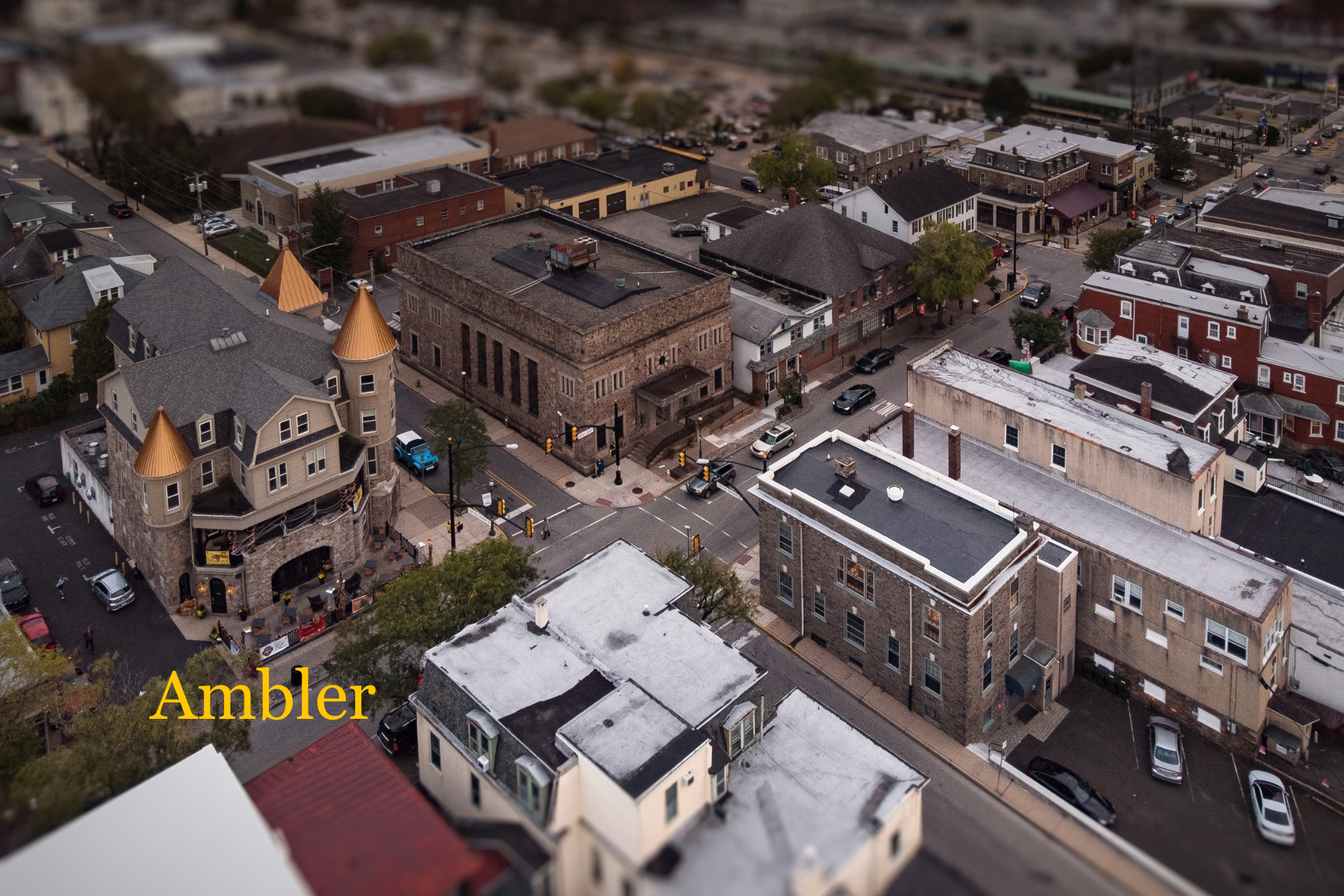
Some suburban towns have always had an easy reputation. Ambler earned its current one the harder way. Over the past two decades, the borough has turned a once quieter downtown into one of Montgomery County’s most recognizable walkable centers, anchored by Butler Avenue, a restored movie theater, restaurants, local businesses, community events, and a Regional Rail station that keeps Philadelphia within reach.
That comeback is a big reason buyers now put Ambler on the same shortlist as other desirable walkable Montgomery County communities. But the town is more interesting than the polished version seen on a Saturday night. Ambler has older housing, tight borough lots, twins, substantial singles, train traffic, parking considerations, industrial history, and an asbestos legacy that deserves an honest explanation rather than avoidance.
For buyers, the appeal comes from understanding the whole place. Matt Albright and Albright Real Estate help buyers compare Ambler at the street and property level, not simply fall for the downtown. The right house here can combine walkability, architecture, rail access, community life, and a strong Montgomery County location in a way few suburbs manage.
Why Ambler really is a comeback borough
Ambler’s current popularity did not appear overnight. The downtown revitalization effort took shape in the late 1990s as local residents, business owners, and community organizations worked to strengthen Butler Avenue as a social and commercial center.
Today, that work is visible. Restaurants bring people downtown throughout the week. Local shops fill storefronts. Community events turn Butler Avenue into a gathering place. The theater gives the town a cultural anchor. The train station gives commuters another reason to consider living within walking distance.
The difference matters for buyers. There are suburban communities with good housing but no center. There are towns with restaurants but poor transit. There are commuter towns where the station is useful but the surrounding area feels disconnected. Ambler brings those pieces together in a compact borough.
Ambler Theater is more than a landmark
The Ambler Theater is one of the clearest symbols of the borough’s transformation. Opened in 1928, the Spanish Colonial style theater eventually faced the same pressures that hurt many independent movie houses. Its later restoration became part of Ambler’s wider downtown revival.
Today, the nonprofit theater functions as a real community institution rather than a decorative historic building. Buyers interested in the story can read the history and restoration of the Ambler Theater, including the recreation of its famous neon tower and the renovation work that brought the building back to life.
Why does the Ambler Theater matter to someone shopping for a house? Because successful town centers need anchors. A theater gives people a reason to come downtown in the evening, meet friends, have dinner, and stay in the borough rather than drive somewhere else for entertainment.
That activity supports the restaurants and small businesses around it. For residents, it means the downtown is useful after work and on weekends, not simply during business hours.
A Main Street that people actually use
Butler Avenue is one of Ambler’s strongest selling points because it functions as more than a collection of pretty storefronts. Residents use it.
There are restaurants, coffee, entertainment, professional services, independent businesses, and community events. The Farmers Market, First Fridays, festivals, restaurant weeks, and seasonal events give the downtown a year-round rhythm.
That creates a different daily experience from many suburban neighborhoods. Someone living close to downtown may walk for dinner, grab coffee on a weekend morning, catch a movie, or meet friends without planning an entire car trip.
What walkability means in Ambler
- Restaurants and entertainment within the borough center.
- A real train station within the downtown fabric.
- Small businesses and services mixed into the commercial district.
- Community events that routinely bring residents downtown.
- Residential streets beginning only a short distance from Butler Avenue.
This is one reason Ambler attracts people who like the convenience of city neighborhoods but want a smaller suburban setting.
The train station changes who Ambler works for
Ambler Station provides Regional Rail access on SEPTA’s Lansdale/Doylestown Line. For buyers who work in Center City or use a hybrid schedule, that connection is a meaningful part of the housing decision.
It also changes the value of location within Ambler. A house that puts the station within a comfortable walk can be attractive to a buyer who wants to reduce driving. Someone farther from the station may care more about driveway parking and quick road access.
Before buying, test the real commute
- Walk from the property to the station rather than relying on the map.
- Check the train schedule against your actual work hours.
- Think about how often you need to commute each week.
- Consider school drop-off or childcare before the train.
- Look at street and driveway parking when you return in the evening.
A train station adds value when it fits your routine. The best Ambler location is the one that works on a normal Tuesday, not only during a weekend showing.
Houses for sale in Ambler: what buyers actually find
Houses for sale in Ambler do not come in one predictable format. The borough’s age gives buyers a varied housing stock, and that variety is part of its appeal.
Albright Real Estate’s current houses for sale in Ambler and local property listings are a useful starting point because buyers need to see what is actually available rather than assume every Ambler home is a large historic single.
Small borough twins
Twins are an important part of the Ambler market. They often give buyers a way into the borough at a more approachable price than larger detached homes. Many have porches, basements, modest yards, and practical layouts.
For first-time buyers, these can offer a strong combination of ownership and location. The tradeoffs may include tighter bedrooms, older systems, limited parking, smaller kitchens, or less storage than newer suburban construction.
Older detached homes
Ambler also has detached singles with significantly more character and size. Depending on the street, buyers may encounter older colonials, substantial traditional homes, properties with porches, larger yards, original woodwork, additions, and renovations completed over several decades.
These homes can be beautiful, but age should be taken seriously. Roofs, electrical systems, plumbing, basements, chimneys, windows, additions, and drainage deserve careful inspection.
Updated and renovated properties
As Ambler has become more desirable, more older houses have been renovated. Updated kitchens, finished basements, open first floors, new HVAC, rebuilt decks, and modern bathrooms can move a property into a different price category.
Buyers should still look beyond finishes. A renovated kitchen does not prove that the sewer lateral, roof, electrical service, or foundation has been addressed.
Housing outside the borough core
Buyers using “Ambler” in an online search will also encounter properties in surrounding communities and townships that use an Ambler mailing address. Some offer larger lots, newer subdivisions, and a more traditional suburban feel.
That is why Matt helps buyers distinguish between living in Ambler Borough and having an Ambler mailing address. The lifestyle can be quite different.
How Ambler compares with the rest of Montgomery County
Ambler attracts buyers who are also considering Hatboro, Jenkintown, Glenside, Lansdale, Conshohocken, Blue Bell, Fort Washington, and other Montgomery County communities.
For shoppers who are not committed to a single borough, Montgomery County homes for sale across walkable towns and suburban neighborhoods make it easier to compare what the same budget buys elsewhere.
The Ambler premium is often tied to the combination of walkability, restaurants, rail access, and housing character. A buyer may get more square footage somewhere else. The question is whether more house is worth giving up the town-center lifestyle.
What Saturday morning feels like here
Saturday is when Ambler makes the most sense to someone considering a move.
The borough does not feel like a downtown built only for visitors. Residents are getting coffee, shopping at the Farmers Market in season, walking dogs, meeting friends, taking children into town, heading to restaurants, and moving between the residential streets and Butler Avenue.
There is enough activity to feel social without the constant intensity of a larger city neighborhood. That balance attracts young professionals, families, downsizers, and buyers coming from Philadelphia who are not ready for a car-only suburb.
Who tends to move to Ambler?
First-time buyers with some flexibility
Ambler is no longer the inexpensive secret it once was, but smaller twins and older properties can still give first-time buyers an entry point. These buyers often value the train and downtown enough to compromise on square footage.
Philadelphia buyers moving outward
People leaving neighborhoods such as Manayunk, Roxborough, East Falls, or Northwest Philadelphia may find Ambler familiar in a useful way. They still get restaurants, walking, rail access, and older architecture, but in a smaller Montgomery County setting.
Families
Families often consider Ambler because of the surrounding school options, neighborhood streets, community programming, parks, and access to suburban employment centers. Exact school assignments should always be verified by address because an Ambler mailing address can cross municipal and district lines.
Hybrid commuters
A buyer who travels into Philadelphia two or three days a week may find Ambler especially appealing. The train gives them a practical city connection without making the commute the center of every day.
Downsizers
Downsizers who do not want isolated suburban living often value the ability to reach restaurants, entertainment, shops, and community events within a compact area.
The asbestos history should be discussed honestly
Ambler has an industrial history that includes asbestos manufacturing. Ignoring that history does buyers no favors.
Keasbey & Mattison became a major local manufacturer of asbestos products, and industrial disposal left contaminated areas that later required federal environmental cleanup. The BoRit Asbestos site became a federal Superfund site, and EPA remediation included covering contaminated areas, stabilizing waterways and completing construction work intended to control the contamination.
Buyers who want primary-source information should review EPA information about the BoRit Asbestos Superfund site and remediation in Ambler.
The important real estate lesson is not to label the entire borough based on its industrial past. It is also not to pretend the history never happened.
A buyer considering a property should look at the exact location, review available environmental information, examine required disclosures, and ask questions when proximity to former industrial areas is relevant. Environmental history is location-specific. It should be evaluated with facts rather than assumptions.
Does Ambler’s asbestos history mean old houses contain asbestos?
These are two separate issues that buyers sometimes combine.
Ambler’s industrial asbestos legacy involves manufacturing and disposal sites. Separately, older houses throughout Pennsylvania and the rest of the country may contain building products manufactured during eras when asbestos was commonly used.
A house does not contain asbestos simply because it is in Ambler. Likewise, an older house outside Ambler may contain materials historically manufactured with asbestos.
Buyers planning significant renovation should understand what materials may be disturbed and use appropriate testing or qualified professionals where warranted. The same principle applies to older housing across Montgomery County.
What buyers should inspect in Ambler’s older homes
The borough’s housing age makes inspection especially important. Character is valuable, but character should not distract from systems.
Basements and drainage
Look for moisture, staining, grading issues, sump systems, foundation condition, and evidence of previous water entry.
Electrical systems
Older homes may have been updated in stages. An inspector should review the panel, visible wiring, grounding, receptacles, and signs of amateur modifications.
Roofs and chimneys
Age, flashing, masonry, liner condition, and previous repairs matter. Ask for records when available.
Plumbing and sewer lines
Older underground laterals deserve consideration, especially when mature trees are nearby. A sewer scope may provide useful information beyond the standard inspection.
Additions
Many older homes were expanded over time. Buyers should pay attention to how additions were built, heated, flashed, wired, and connected to the original structure.
Parking deserves a real conversation
Walkable boroughs often come with parking compromises, and Ambler is no exception.
Some homes have driveways and garages. Others depend more heavily on street parking. Downtown activity and commuter parking can affect certain areas differently throughout the day.
Buyers should visit a property in the evening and on a weekend. A showing at 11 a.m. does not tell you where two cars will go at 8 p.m.
For people who work remotely or use the train regularly, limited parking may not matter much. For a household with three drivers, it may shape the entire decision.
Ambler versus Hatboro
Hatboro and Ambler both give buyers a train station, a recognizable main street, local restaurants, older housing and a strong borough identity.
Hatboro can offer a more approachable price point in some segments. Ambler often has a stronger restaurant and entertainment draw and a downtown transformation that has built considerable demand.
The choice often comes down to budget, school needs, commute, property type, and how much buyers value Ambler’s downtown atmosphere.
Ambler versus Jenkintown
Jenkintown is closer to Philadelphia and has excellent rail connectivity. Ambler sits farther out but offers its own strong downtown and access to Route 309, the Pennsylvania Turnpike and surrounding Montgomery County employment centers.
Buyers should compare total commute rather than distance alone. The best location depends on where everyone in the household actually travels.
Ambler versus Conshohocken
Conshohocken offers newer apartments, offices, restaurants and quick highway access, with a more modern development feel in parts of town. Ambler has a more traditional borough scale and older residential architecture.
A buyer attracted to historic homes, Butler Avenue and a classic main street may prefer Ambler. Someone prioritizing proximity to major office corridors or newer housing may lean toward Conshohocken.
What sellers should understand about Ambler buyers
Ambler buyers are often purchasing the house and the town together. That makes location within the borough important.
Sellers should explain practical advantages accurately. Walking distance to Butler Avenue, station access, driveway parking, updated systems, usable outdoor space, and renovations with good documentation can all influence value.
Older homes should be prepared honestly. Buyers are less concerned by age when they see evidence that the property has been maintained. A clean basement, service records, updated electrical work, roof documentation and organized disclosure information can build confidence.
Pricing an Ambler home
Ambler cannot be priced from a ZIP code average. A small twin close to downtown competes differently from a large detached house. A renovated home with a driveway does not compare directly with an original-condition property lacking parking. A borough home may attract a buyer who would not consider a larger property farther away from Butler Avenue.
Matt looks at recent comparable sales, active listings, pending activity, condition, lot, parking, school assignment, renovation quality, station proximity and the specific buyer pool before recommending a price.
In a town with varied housing, choosing the right comps matters as much as doing the math.
The buyer takeaway
Ambler’s comeback is real because the borough rebuilt more than its appearance. It rebuilt a working downtown. The restored Ambler Theater, Butler Avenue businesses, community events and train station now support a daily lifestyle that draws buyers from across Montgomery County and Philadelphia.
The housing reflects the borough’s age and history. Buyers will find smaller twins, older detached homes, renovated properties and larger houses around the surrounding area. They will also encounter the realities that come with an established town: older systems, tighter lots, parking differences and an industrial history that includes asbestos manufacturing and federally managed cleanup sites.
None of those details should be hidden, and none should automatically define the entire town.
For someone comparing Montgomery County communities, Ambler works best when its strengths and tradeoffs line up with real life. You get a genuine downtown, a train station, an independent theater, established architecture and a community that looks substantially different from the Ambler of twenty years ago.
That combination is why houses for sale in Ambler receive so much attention today. Buyers are not only buying square footage. They are buying into one of Montgomery County’s clearest examples of what can happen when an older borough finds its center again.